Opening a UK business bank account from Sri Lanka can help entrepreneurs manage international payments, build credibility with overseas clients, and simplify business operations. However, the process can seem complicated if you are unfamiliar with UK banking requirements, eligibility rules, and the documents you need to provide.
In this guide, we explain everything you need to know about opening a UK business bank account from Sri Lanka in 2026, including the available options, required paperwork, common challenges, and practical tips to improve your chances of approval. Read on to learn how to choose the right banking solution for your business and get started with confidence.
Can Sri Lankans Open a UK Business Bank Account?
Yes, Sri Lankans can open a UK business bank account. There’s no nationality restriction that blocks Sri Lankan citizens or residents from holding one, and thousands of entrepreneurs based in Sri Lanka already manage UK accounts for their businesses.
The catch is what comes before the bank account. Banks in the UK don’t open business accounts for individuals trading from abroad on their personal name alone. They open accounts for registered UK companies. So before you even start looking at which bank to apply with, you need a UK limited company on record with Companies House, complete with a company number, a registered office address, and clear details of the directors and shareholders.
This is the step most people underestimate when they search for how to get a UK bank account from Sri Lanka. Skipping straight to a bank application without a registered company is the most common reason applications stall before they even reach the verification stage. Once the company exists on paper, the bank has something concrete to check your application against, which makes the rest of the process far smoother.
If you haven’t registered your company yet, that’s the place to start. It typically takes a day or two, costs very little, and opens the door to every banking option covered later in this guide, from traditional high street banks to digital providers built specifically for non-resident founders.
Why Open a UK Business Bank Account
A UK business bank account does more than just hold money. Here’s what it actually gets you:
- Separates business and personal finances: Keeping company money apart from your own makes bookkeeping cleaner and protects you if questions ever come up about what’s a business expense and what isn’t.
- Builds credibility with UK clients: A UK account number and sort code signal that you’re a real, locally operating business, which matters when you’re invoicing UK customers or pitching to UK partners.
- Simplifies HMRC tax filing: With all business income and expenses running through one dedicated account, preparing your accounts and filing with HMRC becomes far less of a headache than untangling mixed transactions.
- Gives you access to GBP and multi-currency tools: You can hold, send, and receive pounds directly, avoiding repeated currency conversion losses, and most providers also let you hold other currencies alongside GBP.
- Makes payment gateway setup easier: Platforms like Stripe and Paddle work far more smoothly with a UK business bank account behind them, which matters if you’re planning to take online payments from customers.
What You Need Before You Apply to Open a UK Business Bank Account from Sri Lanka
Before any bank or digital provider will even look at your application, you need a few things in place. These aren’t optional extras, they’re the baseline every provider checks against.
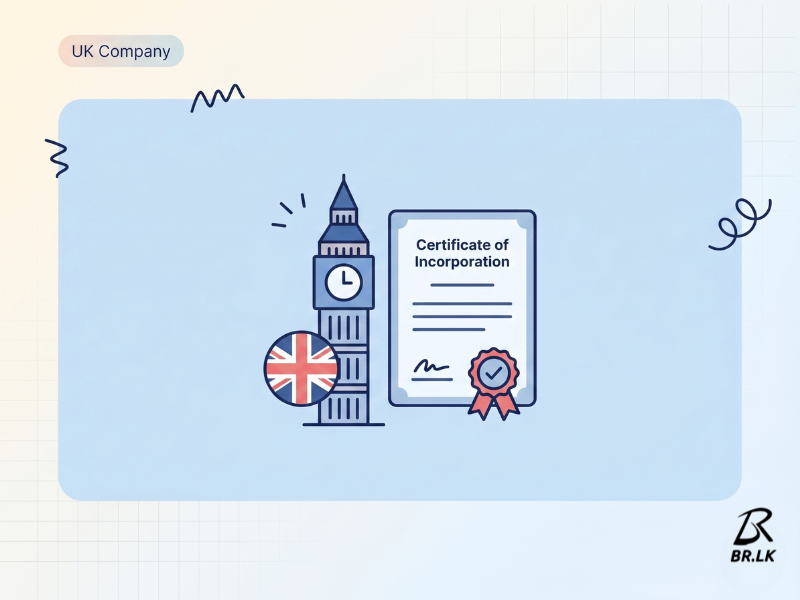
- A registered UK limited company: You’ll need your certificate of incorporation from Companies House along with your company number (CRN). This is the document that proves your business legally exists in the UK, and no bank will move forward without it.
- A UK registered office address: Every UK company needs an official address on record with Companies House. This doesn’t need to be a physical office you rent yourself, a virtual office address works fine and is what most non-resident founders use.
- Director and shareholder (PSC) details: Banks need full details of everyone with significant control over the company, including directors and People with Significant Control (PSCs). This includes names, dates of birth, nationality, and residential addresses, since each person will go through their own identity check before the account is approved.
Having these three things sorted before you apply saves you from the back-and-forth that slows most applications down. Once your company is registered and your director details are ready, you’re in a position to start gathering the personal documents covered next.
Documents Required From Sri Lanka
With your company registered, the next step is pulling together the documents banks will actually ask to see. Here’s what to have ready when you’re applying from Sri Lanka.
- Proof of identity: A valid Sri Lankan passport is the most widely accepted document, though some providers also accept your National Identity Card (NIC). Make sure it’s current and not close to expiry, since an expired or soon-to-expire ID can hold up verification.
- Proof of address: A Sri Lankan utility bill or recent bank statement showing your name and address usually works for digital banks. Worth noting though, some traditional UK banks insist on a UK residential address specifically, which is one of the bigger hurdles for Sri Lanka-based applicants and a reason digital providers tend to be the easier route.
- Business documents: This means your certificate of incorporation and articles of association, the same documents that confirm your company’s legal structure and existence. Banks use these to verify that the business itself is legitimate before they look at who’s behind it.
- Apostille, notarization, and certified translation: Since your supporting documents are issued in Sri Lanka, some banks will ask for them to be apostilled or notarized to confirm authenticity, and translated into English by a certified translator if they aren’t already in English. Not every provider asks for this, but it’s worth checking before you apply rather than after.
- Business activity proof: Stricter banks, particularly traditional high street ones, may want evidence that your business is actually trading or about to trade, things like signed contracts, invoices, or a clear explanation of what you sell and to whom. This is less common with digital providers but worth having on hand regardless.
Getting these documents lined up in advance is what separates a smooth application from one that drags on for weeks waiting on paperwork.
Bank Options for Sri Lankan Founders
Once your documents are ready, the next decision is which bank or provider to actually apply with. Your options generally fall into three categories.
1. Traditional High Street Banks (HSBC, Barclays, Lloyds, NatWest)
These are the names most people think of first, but they’re also the hardest route for someone applying from Sri Lanka. Most of them require at least one director to travel to the UK for an in-person meeting before the account can be opened, which isn’t realistic for everyone.
On top of that, expect minimum deposit requirements that can run into thousands of pounds, plus a review process that often takes anywhere from a few weeks to a few months. They’re not impossible, but they’re built more for businesses with an existing UK presence than for founders running things entirely from Sri Lanka.
2. Digital Banks and EMIs (Wise Business, Revolut Business, Tide, GoSolo, Monzo Business)
This is where most Sri Lanka-based founders end up, and for good reason. These providers let you complete the entire application online, with identity verification done through a video call or app rather than a branch visit.
Here, approval is typically measured in days rather than weeks, and residency demands are far looser. Several of these providers don’t require a UK proof of address at all. For most small businesses and solo founders, this route gets you trading faster with far less friction.
A quick note before moving on:
If you already hold a corporate banking relationship with a multinational bank like HSBC or Standard Chartered, it’s worth asking whether that can be extended into the UK. But following the HSBC retail exit from Sri Lanka in 2026, this no longer applies to personal account holders, so for most readers, the digital bank route above is the realistic one to plan around.
Step-by-Step Process to Open the Account
By this point you’ve got your company structure sorted and your documents ready, so here’s how it all comes together.
- Register your UK limited company: If you haven’t already, this is the first move; everything else depends on it. You’ll get your certificate of incorporation and company number from Companies House, which every bank or provider will ask for.
- Choose a bank or digital provider suited to non-residents: Based on what we covered earlier, most Sri Lanka-based founders will get further, faster with a digital provider like Wise Business, Tide, or GoSolo rather than a traditional high street bank. Pick one that explicitly supports non-resident applicants before you invest time in the application.
- Gather and prepare documents: Pull together your passport, proof of address, and incorporation documents. If the provider requires it, get any Sri Lanka-issued documents apostilled or notarized, and translated into English by a certified translator.
- Complete the online application or book a verification call: Most digital providers let you start the application directly on their website or app. Some will ask you to book a short video call as part of the process, so check what’s expected before you begin.
- Submit documents and complete ID/video verification: Upload your documents through the provider’s portal and complete identity verification, usually a quick selfie or video check matched against your passport. This step is where most of the waiting happens, so make sure your documents are clear and current to avoid delays.
- Wait for approval and receive account details: Approval times vary, digital providers often confirm within a few days, while traditional banks can take weeks. Once approved, you’ll receive your UK sort code and account number, the details you’ll need to start invoicing and receiving payments.
- Set up online banking and order a debit card: With the account active, log in to set up online banking, add team members if needed, and order your debit card. From here, you’re ready to start using the account for day-to-day business transactions.
Common Reasons for Rejection
Even with everything prepared, applications still get turned down. Here’s what usually causes it.
- Missing UK proof of address: Some banks, particularly traditional high street ones, expect a UK residential address for directors. Showing up with only a Sri Lankan address can be enough to get the application rejected outright at certain banks, which is why checking a provider’s address policy before applying matters.
- Weak business activity proof: If a bank can’t tell what your business actually does, who it serves, or how it makes money, that’s a red flag in their eyes. Vague answers about business activity, or no supporting contracts or invoices when asked, often lead straight to rejection.
- Incomplete KYC/AML documentation: Banks are legally required to verify who they’re banking with, and gaps in your identity or address documents, even small ones like an expired passport or a utility bill older than three months, can stall or kill an application.
- Unclear business plan: Some banks, especially for larger or newer businesses, want to see where the money is coming from and going. A business plan that’s vague on revenue sources, target customers, or operations gives the bank little to approve.
- No UK-based director when required: A handful of banks, Lloyds being one example, require at least one director who lives in the UK. If your company is entirely Sri Lanka-based with no UK resident on the board, those specific banks simply aren’t an option, no matter how complete your paperwork is.
Knowing these in advance means you can either fix the gap before applying or choose a provider whose requirements actually match your situation.
Tips to Improve Your Approval Chances
A few small adjustments before you apply can make the difference between approval and rejection.
- Register the company first: Don’t apply for a bank account before your UK limited company actually exists on Companies House. Banks need to see a real, registered entity to check your application against, and applying too early is one of the fastest ways to get turned down before you even start.
- Prepare a clear one-page business plan: You don’t need anything elaborate, just a short summary covering what your business does, who your customers are, and where your revenue comes from. Having this ready, even if the bank doesn’t explicitly ask for it, removes one of the most common points of friction in the review process.
- Choose a provider known to work with non-residents: Not every bank treats non-resident applications the same way, and applying to one that isn’t set up for it just wastes time. Stick to providers that explicitly mention non-resident or international founder support, since their entire verification process is built around exactly your situation.
- Keep all documents current and properly translated: A passport, utility bill, or bank statement older than three months is one of the easiest reasons for a bank to reject an application. The same goes for any Sri Lanka-issued document that isn’t in English, get it translated by a certified translator before submitting, rather than waiting for the bank to ask.
Get these four right and you’ve already avoided most of the reasons applications fall through.
Costs and Fees to Expect
Costs vary a fair bit depending on whether you go with a traditional bank or a digital provider, so it’s worth knowing what to expect before you commit.
- Monthly account fees: Many digital providers offer free or low-cost accounts, often in the £0 to £10 range, while traditional high street banks tend to charge more, sometimes with the fee waived if you maintain a certain balance.
- Minimum deposit requirements: This is where traditional banks stand out the most. Some, like Barclays’ offshore accounts, can require a minimum deposit of several thousand pounds within the first month of opening. Digital providers generally don’t impose this kind of requirement, which is part of why they’re more accessible for smaller businesses.
- Foreign exchange margins: If you’re converting between GBP and LKR, or any other currency, the exchange rate you actually get matters as much as the headline fee. Traditional banks often apply wider margins above the market rate, while providers like Wise Business are built specifically around offering rates closer to mid-market.
- International transfer charges: Sending or receiving money across borders usually comes with a flat fee, a percentage charge, or both. These add up quickly if you’re regularly paying suppliers or receiving payments from clients outside the UK, so it’s worth comparing a provider’s transfer fees against your expected transaction volume, not just their account fee.
Looking at all four together, rather than just the monthly fee, gives a much more honest picture of what an account will actually cost you over a year.
Ready to Open a UK Business Bank Account from Sri Lanka?
At BR.lk, we help Sri Lankan freelancers, online sellers, and entrepreneurs register their UK company and get a UK business bank account set up the right way, so you can start accepting international payments and operating like a genuine UK business without trying to figure out banking and compliance on your own.
Here is what we handle for you:
- Full UK Company Registration: We manage the entire Companies House registration process, including mandatory identity verification, so your company is set up correctly and ready to apply for a bank account from day one.
- UK Registered Office Address: Every package includes a legitimate UK business address, which is a legal requirement for all UK companies and one of the documents banks will ask for.
- Bank Account and Payment Gateway Setup: We guide you to the right bank or digital provider for non-residents, then help you connect your new UK company to Stripe, Wise, PayPal, and other global payment platforms so you can start getting paid internationally.
- Fast Turnaround: Your UK company can be registered within 24 to 48 hours, with clear guidance on the bank account application at every step.
- Local Language Support: Our team is available in Sinhala and Tamil, making the entire process simple and easy to follow from Sri Lanka.
Take the first step toward opening your UK business bank account from Sri Lanka.
Conclusion
Opening a UK business bank account from Sri Lanka is more achievable than ever in 2026, especially with the growth of digital banking providers that support non-resident business owners. The key to a successful application is having a properly registered UK company, preparing the required documents in advance, and choosing a provider that is designed to work with international founders.
While traditional UK banks may still present challenges for overseas applicants, digital banking solutions offer a faster and more accessible path to managing international payments and business finances. By understanding the requirements, avoiding common mistakes, and keeping your documentation up to date, you can significantly improve your chances of approval.
Whether you are a freelancer, e-commerce seller, consultant, or entrepreneur, a UK business bank account can help you operate more professionally, receive payments in GBP, and expand your business globally. Taking the time to set everything up correctly from the start will save you time, money, and frustration in the long run.
Key Takeaways
- Sri Lankans can open a UK business bank account, but they must first register a UK limited company.
- A UK company registration with Companies House is usually required before applying for a business bank account.
- Most banks require a UK registered office address and full director and shareholder details.
- Applicants typically need a valid passport, proof of address, and company formation documents.
- Digital banking providers are often more accessible for Sri Lankan founders than traditional UK high street banks.
- Providers such as Wise Business, Revolut Business, Tide, and GoSolo allow applications to be completed online.
- Strong business activity evidence and accurate KYC documentation can improve approval chances.
- Common reasons for rejection include missing documents, weak business information, and address-related issues.
- Costs may include monthly account fees, foreign exchange charges, and international transfer fees.
- A UK business bank account can help entrepreneurs receive international payments, manage finances professionally, and build credibility with UK clients.
FAQs
No, not with most providers. Digital banks like Wise Business, Tide, and GoSolo let you complete the entire application online with video verification. Traditional banks such as HSBC and Barclays often still require an in-person branch visit before approving the account.
It depends on the provider. Digital banks generally accept a Sri Lankan utility bill or bank statement. Traditional high street banks often insist on a UK residential address, which is one of the main reasons non-residents lean toward digital providers instead.
Digital banks are faster. Providers like Wise Business or Tide typically approve applications within a few days. Traditional banks such as HSBC, Barclays, or Lloyds can take anywhere from a few weeks to a few months to complete their review.
Not always, but some banks require it. Lloyds, for example, requires at least one UK-resident director. Most digital providers don’t have this requirement, making them more practical for companies run entirely by Sri Lanka-based directors.
It varies by provider. Traditional banks can require several thousand pounds, Barclays offshore accounts being one example, within the first month. Most digital providers like Wise Business or Tide don’t impose minimum deposit requirements at all.
No. A UK business bank account is tied to your registered company, not your immigration status. You don’t need a visa or UK residency to apply, though you will need valid identification and the standard company documentation.