Starting a US LLC from Sri Lanka can be an excellent way to access global markets, receive international payments, and build a business with a strong international presence. However, many entrepreneurs focus only on the formation fee and overlook the ongoing costs that come with maintaining an LLC. From state filing fees and registered agent charges to annual compliance and tax filing expenses, understanding the full cost of ownership is essential before getting started.
In this guide, we break down the 7 key US LLC costs and annual fees that non-residents need to budget for in 2026. Read on to learn what expenses to expect, how much they typically cost, and how to avoid unexpected fees that could affect your business.
1. Initial Formation Costs
The first cost you’ll pay is the state filing fee for your Articles of Organization. This is what legally creates your LLC, and every state charges a different amount. Fees range from $35 (Montana) to $500 (Massachusetts), with most states sitting between $50 and $150. Wyoming charges $100, Delaware around $110-$140, and New Mexico just $50.
Before filing, you’ll also need to check if your chosen LLC name is available. This is free and takes a few minutes on the Secretary of State’s website for your chosen state.
As a Sri Lankan, you can file the Articles of Organization yourself directly on the state website, or use a formation service that handles the paperwork for you. Filing yourself saves money but means you handle the documents, payment, and any follow-up directly with the state. A formation service charges an extra fee, usually $0–$300 on top of the state fee, but takes care of the filing for you and often bundles in a registered agent for the first year.
For most Sri Lankans starting an online business, the total initial formation cost (state fee plus a basic formation service) lands between $100 and $400, depending on the state you pick. This is a one-time payment. It does not cover what you’ll pay every year after, which we’ll cover next.
2. Registered Agent Fees
Every US state requires your LLC to have a registered agent. This is a person or company with a physical street address in the state where your LLC is formed, available during normal business hours to receive legal documents and official mail on the LLC’s behalf.
As a Sri Lankan, you can’t act as your own registered agent because you don’t have a US address. This makes a registered agent service a required cost, not an optional one.
Registered agent services typically cost between $50 and $200 per year. Some providers charge as little as $39/year, while others bundle it with extra services and charge closer to $200/year. The price difference usually comes down to what’s included, such as mail scanning, compliance reminders, or same-day document forwarding.
Many formation services include the first year of registered agent service for free as part of their package. After that first year, you’ll need to pay the renewal fee directly, so it’s worth checking the renewal price before signing up, since some providers raise the price after year one.
If you skip this service or let it lapse, your LLC can fall out of good standing with the state, and in serious cases, the state can dissolve your LLC entirely. Since this is a required, recurring cost, it’s one of the line items you should budget for every single year your LLC is active, not just at formation.
3. EIN Application Cost
An EIN (Employer Identification Number) is your LLC’s federal tax ID. You need it to open a US bank account, set up payment processors like Stripe or PayPal, and file taxes. Without an EIN, your LLC exists on paper but can’t legally move money.
Getting an EIN is free. The IRS does not charge anything for it, no matter who applies. The challenge for Sri Lankans isn’t the cost, it’s the process.
US residents apply online using their Social Security Number and get an EIN within minutes. As a non-resident without an SSN, you cannot use the online system.
Instead, you have two main options:
- By fax: Fill out Form SS-4 and fax it to the IRS. Processing usually takes 10–15 business days.
- By mail: Send the same form by post. This takes longer, often 4–6 weeks, since it depends on international mail delivery.
Some applicants also try calling the IRS’s international applicant line directly, though this can involve long wait times and isn’t always reliable from overseas.
Since the EIN itself is free, the only real cost here is your time and patience. Some formation services offer to handle the EIN application for you as part of their package, usually for a separate fee since it isn’t something the IRS charges for. If you’re comfortable filling out one form and waiting a few weeks, you can skip that fee and do it yourself at no cost.
4. Annual State Compliance
Once your LLC is formed, most states require you to file an annual report (sometimes called an annual fee, license tax, or franchise tax) to keep your business in good standing. This is separate from the one-time filing fee you paid to form the LLC, and it’s a cost you’ll pay every year your LLC stays active, regardless of how much money it makes or even if it makes none at all.
The amount varies a lot by state:
- Wyoming charges a $60/year license tax, one of the lowest in the country.
- Delaware charges a flat $300/year franchise tax, regardless of your LLC’s income.
- New Mexico is one of the few states with no annual report requirement at all, making it $0/year in ongoing state fees.
- Other US states fall somewhere in between, usually $25 to $300 per year, with California being the most expensive at an $800/year minimum franchise tax.
This fee is paid directly to the state, not to your registered agent or formation service, though some services will remind you or file it on your behalf for an added charge.
Missing this deadline has real consequences. Your LLC first gets marked as “not in good standing,” which can block you from opening bank accounts or signing contracts. If it stays unpaid, the state can administratively dissolve your LLC, meaning it stops legally existing.
5. Federal Compliance Costs (Form 5472 + Form 1120)
This is the cost most guides skip, and the one that catches Sri Lankans off guard the most.
If your US LLC is 25% or more foreign-owned, which applies to almost every Sri Lankan-owned LLC, you’re required to file Form 5472 along with a pro forma Form 1120 every year. This filing is due by April 15th. It’s an informational form, meaning you’re reporting transactions between you and your LLC to the IRS, not necessarily paying tax on them.
Filing the form itself is free. The cost comes from preparing it correctly. Most Sri Lankans hire a CPA familiar with foreign-owned LLC filings, since the form needs to be filled out precisely and tied to your LLC’s transactions. This typically costs $500 to $2,000 per year, depending on how complex your LLC’s activity is.
Here’s why this matters so much: the penalty for missing this form, filing it late, or filing it incomplete is $25,000 per form, per year. There’s no smaller penalty tier. If you miss it for two years, you’re looking at $50,000 in penalties before anything else is even considered.
Many new LLC owners don’t learn about this requirement until a tax advisor flags it, sometimes years later. Budgeting for a CPA upfront is far cheaper than risking this penalty, and it should be treated as a required annual cost, not an optional one.
6. Banking & Payment Setup Costs
Once you have your EIN, the next step is opening a US business bank account. This is what lets you receive payments from clients or customers, and it’s required if you want to keep your business and personal money separate.
The good news for Sri Lankans is that you don’t need to visit the US in person for this. Fintech platforms like Mercury, Relay, and Wise Business all support fully remote account opening for non-residents.
You’ll typically need:
- Your EIN confirmation letter,
- Certificate of Formation,
- Operating Agreement,
- A valid passport.
- Some platforms may also ask for a utility bill or bank statement from Sri Lanka as proof of address.
Traditional banks like Chase or Bank of America usually require an in-person visit to a US branch, which makes them impractical for most non-residents unless you’re already planning a trip.
As for cost, opening an account with Mercury, Relay, or Wise is generally free, with no monthly fees for the basic business account. Some formation services bundle in a “guaranteed” bank account setup or connect you to a banking partner, charging $50 to $250 per year for this. This is often unnecessary if you can open an account directly with Mercury or Wise yourself.
Budget for $0 if you go direct, or factor in the extra fee only if you’re using a bundled service for convenience.
7. Optional but Common Extra Costs
Beyond the required costs, there are a few extra expenses that aren’t mandatory for every Sri Lankan LLC owner, but come up often enough to plan for.
- Operating agreement: This document outlines how your LLC is managed and how decisions are made. It’s not required by most states, but it’s strongly recommended, especially if you ever open a bank account or work with partners. You can use a free template for a single-member LLC, or pay an attorney $500–$2,000 for a custom one if your structure is more complex.
- ITIN (Individual Taxpayer Identification Number): If you need to file personal US taxes or want access to certain banking and payment platforms, you may need an ITIN. Applying through the IRS is free, but the process takes time and paperwork, and some services charge a fee to assist with it.
- Bookkeeping: Keeping clean records makes your annual filings (including Form 5472) much easier and cheaper to prepare. Basic bookkeeping software runs $10–$30/month, while hiring a bookkeeper or accountant can cost $100–$500/month depending on your transaction volume.
- Business insurance: Not required to legally operate, but useful if you’re working with clients who ask for it, or if your business carries risk. General liability insurance typically costs $300–$1,000/year.
None of these are mandatory on day one, but most active LLCs end up needing at least one of them within the first year.
Major State Wise Cost Comparison for US LLC Costs & Annual Fees for Non Residents
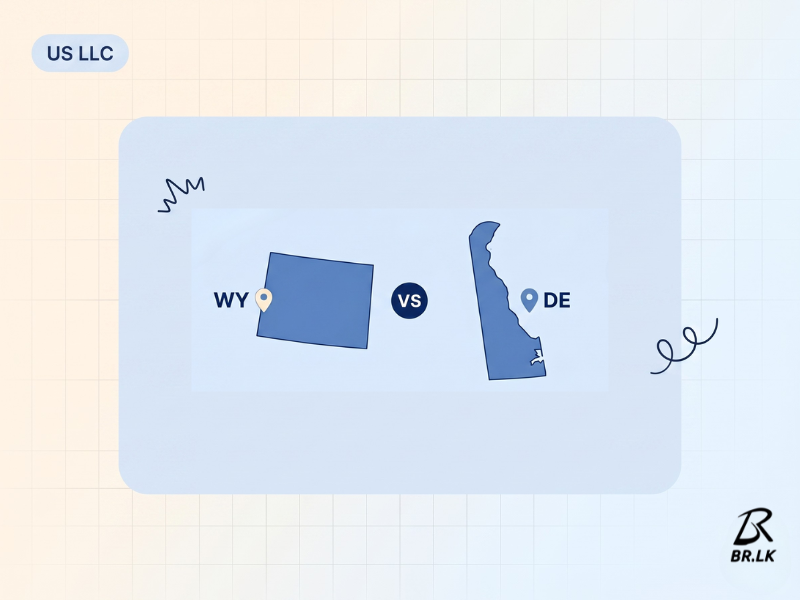
The state you choose affects your cost every single year, not just on day one. Here’s how the most popular states for Sri Lankan non-residents compare:
| State | Filing Fee (One-Time) | Annual Fee | Best For |
| Wyoming | $100 | $60/year | Most non-residents, low cost overall |
| Delaware | $110–$140 | $300/year franchise tax | Startups raising US investment |
| New Mexico | $50 | $0/year (no annual report) | Lowest long-term cost |
| Nevada | $75 + $150 initial list | $150/year | Privacy, but higher overall cost |
| Florida | $125 | $138.75/year | US-based operations |
Wyoming and New Mexico are the two most cost-friendly options for Sri Lankans running online businesses with no physical presence in the US. Delaware costs more every year but is worth it only if you’re planning to raise funding from US investors, since its legal system is built around that.
A cheap state upfront can still cost you more over time. For example,
- Nevada, has a low base filing fee, but adds a $150 “initial list of officers” fee right away, then charges $150/year after that, making it more expensive than Wyoming within the first year alone.
- Delaware‘s filing fee looks reasonable, but its $300/year franchise tax applies whether your LLC makes money or not, so by year three, you’ve paid $900 in franchise tax alone.
The better approach is to add up the filing fee plus five years of annual fees before deciding, rather than picking based on the first number you see.
Total Cost Summary: Year 1 vs Year 2 Onward
Now that we’ve covered each cost individually, here’s how they add up.
Realistic Year 1 Total
In your first year, you’re paying for formation, your registered agent, EIN setup (if you use a service), and basic banking setup. For a Sri Lankan going the DIY route in Wyoming, this typically lands between $300 and $500. If you use a full-service formation provider that bundles in registered agent, EIN handling, and operating agreement drafting, expect $700 to $1,500 for the same year.
Realistic Year 2 Onward Total
From year two, formation costs disappear, but three recurring costs remain: your annual state fee ($60–$300 depending on state), registered agent renewal ($50–$200), and Form 5472 preparation if you hire a CPA ($500–$2,000). Add these up and most non-resident LLCs land between $660 and $2,500 per year, every year, regardless of how much the business earns.
DIY Budget vs Full-Service Provider Budget
| DIY (Wyoming) | Full-Service Provider | |
| Year 1 | $300–$500 | $700–$1,500 |
| Year 2+ (per year) | $660–$1,200 | $1,500–$2,500 |
| 5-Year Total | ~$3,500 | $10,000–$12,500 |
The DIY path costs less but means you’re personally responsible for deadlines, filings, and finding a CPA for Form 5472. The full-service path costs more but bundles compliance reminders, filing support, and sometimes banking help into one place.
Neither path is wrong, it depends on how much time you want to spend managing this yourself versus paying someone else to handle it.
Tax Filing Obligations for Sri Lankans
The good news is that owning a US LLC doesn’t automatically mean paying US income tax. A US LLC is a pass-through entity by default, meaning the LLC itself doesn’t pay federal tax. Profits “pass through” to you as the owner, and whether you owe tax depends on where your income comes from, not just where your LLC is registered.
The IRS splits non-resident income into two categories.
- Effectively Connected Income (ECI) is income tied to an actual US trade or business, taxed at regular US rates.
- FDAP income (fixed, determinable, annual, or periodic), like interest or royalties, is usually taxed at a flat 30% withholding rate.
Most Sri Lankans running online businesses with no physical US presence, no US employees, and no US office fall outside both categories. This means they often owe no US federal income tax on their LLC profits.
Important Note:
This doesn’t remove your filing obligations. You’re still required to file Form 5472 every year, as covered earlier, regardless of whether you owe tax.
On the Sri Lankan side, you’re required to declare worldwide income to the Inland Revenue Department, including profits from your US LLC. Since Sri Lanka and the US have had an active tax treaty in force since July 2004, it’s worth checking this treaty (or working with a tax advisor) to avoid being taxed twice on the same income.
In short, no US tax for most non-resident online businesses, but two sets of paperwork to stay on top of, in both countries.
Common Mistakes That Increase Costs
Most of the extra costs Sri Lankans run into aren’t surprises, they’re avoidable mistakes made early on.
- Picking a state by filing fee alone: A low filing fee looks attractive, but it doesn’t tell you the full story. Nevada, for example, has a reasonable base fee but adds a $150 “initial list of officers” charge and a $150/year renewal, making it pricier than Wyoming within the first year. Always check the annual fee alongside the filing fee before choosing a state.
- Skipping Form 5472: This is the costliest mistake on this list, and it’s often unintentional. Many non-residents don’t realize this filing applies to them until a tax advisor flags it, sometimes years later. Since the penalty is $25,000 per missed form, per year, this single oversight can wipe out years of savings from a “cheap” LLC.
- Falling for “$0 LLC” offers that hide renewal costs: Some formation services advertise free LLC setup, but this usually only covers their service fee, not the state filing fee, registered agent, or what happens at renewal. Read the pricing page carefully, since “free” formation often turns into a $300-$700 renewal bill in year two.
- Not budgeting for Year 2: It’s easy to focus only on the formation cost and forget that annual fees, registered agent renewal, and Form 5472 preparation continue every year your LLC is active. Treat Year 2 onward as a recurring business expense, not a one-time setup cost, so you’re not caught off guard when the bills start coming.
Ready to Form Your US LLC Without the Hidden Fees?
At BR.lk, we help Sri Lankan freelancers, online sellers, and entrepreneurs set up their US LLC with transparent, all-in pricing, so you know exactly what you’re paying for, from day one through every renewal year after.
Here is what we handle for you:
- Full US LLC Registration: We file your Articles of Organization with the state and handle the entire setup correctly, with no surprise add-ons once you’ve signed up.
- Registered Agent Included: Every package includes a US registered agent, so you stay compliant without needing a US address of your own.
- EIN & Compliance Handling: We apply for your EIN and make sure your Form 5472 and annual state filings are taken care of, so you never risk the $25,000 penalty for missing a deadline.
- US Bank Account Setup: We help you get set up with Mercury, Wise, or Relay so you can start receiving payments without visiting the US.
- Local Language Support: Our team is available in Sinhala and Tamil, making the entire process simple and easy to follow from Sri Lanka.
Take the first step toward building a global business from Sri Lanka, with no hidden costs along the way.
Conclusion
Setting up a US LLC as a Sri Lankan entrepreneur can be a smart move for accessing international markets, receiving global payments, and building a business with greater credibility. However, the true cost of owning a US LLC goes beyond the initial formation fee. Registered agent services, annual state compliance fees, federal filing requirements, and ongoing administrative costs all play a role in your long-term budget.
Before choosing a state or formation provider, take the time to calculate both your first-year expenses and your ongoing annual costs. A cheaper setup today may not always be the most affordable option over the next five years.
By understanding the seven key costs covered in this guide and planning for them in advance, you can avoid unexpected expenses, stay compliant, and focus on growing your business with confidence in 2026 and beyond.
Key Takeaways
- Forming a US LLC requires a one-time state filing fee, which typically ranges from $50 to $500 depending on the state.
- Non-residents must maintain a registered agent, making it a required annual expense for every US LLC.
- Obtaining an EIN from the IRS is free, although some service providers charge a fee to handle the application process.
- Most states require annual reports, franchise taxes, or renewal fees to keep an LLC in good standing.
- Foreign-owned US LLCs must generally file Form 5472 and a pro forma Form 1120 each year to meet IRS compliance requirements.
- Missing Form 5472 filing deadlines can result in significant IRS penalties, making compliance a critical annual responsibility.
- Remote-friendly banking platforms such as Mercury, Relay, and Wise allow many Sri Lankan entrepreneurs to open US business accounts without travelling to the United States.
- Additional costs such as bookkeeping, ITIN applications, operating agreements, and business insurance may arise as the business grows.
- Wyoming and New Mexico are often the most cost-effective states for Sri Lankan non-residents, while Delaware is typically better suited for businesses seeking investors.
- Calculating both first-year and ongoing annual costs helps entrepreneurs avoid unexpected expenses and make informed decisions about their US LLC.
FAQs
Forming a US LLC typically costs $100–$400 in year one, covering the state filing fee and a registered agent. This is a one-time setup cost and doesn’t include the recurring fees you’ll pay every year after, like state compliance and Form 5472 preparation.
Most non-resident LLCs cost $660–$2,500 per year to maintain, covering the state annual fee ($60–$300), registered agent renewal ($50–$200), and Form 5472 preparation if you hire a CPA ($500–$2,000). The exact amount depends on your state and whether you DIY or use a full-service provider.
Wyoming and New Mexico are the most cost-effective long term. Wyoming charges just $60/year in state fees, while New Mexico has no annual report requirement at all. Delaware is pricier, with a $300/year franchise tax, but suits LLCs raising US investment.
Yes. Every state requires a registered agent with a physical address in the LLC’s state of formation. Since non-residents don’t have a US address, this is a required, recurring cost, typically $50–$200/year, not an optional service.
Getting an EIN from the IRS is free, regardless of residency. The only cost is time, since non-residents can’t apply online and must use Form SS-4 by fax (10–15 business days) or mail (4–6 weeks).
Yes. If your LLC is 25% or more foreign-owned, which applies to nearly all Sri Lankan-owned LLCs, you must file Form 5472 with a pro forma Form 1120 every year by April 15th, even if you owe no US tax.
The IRS penalty for a missed, late, or incomplete Form 5472 is $25,000 per form, per year. There’s no smaller penalty tier, making this the single largest financial risk for non-resident LLC owners who skip professional tax preparation.
Usually not. Most Sri Lankans running online businesses with no US office or employees fall outside taxable categories like ECI and FDAP, so they often owe no US federal income tax, though Form 5472 filing is still required regardless.
Unlikely. Sri Lanka and the US have had an active tax treaty since July 2004 to prevent double taxation. You’re still required to declare worldwide income, including LLC profits, to Sri Lanka’s Inland Revenue Department each year.
Yes. Platforms like Mercury, Relay, and Wise Business support fully remote account opening for non-residents without an SSN. You’ll need your EIN, Certificate of Formation, Operating Agreement, and passport. Traditional banks like Chase usually require an in-person visit.
No. You can form a US LLC, get an EIN, and open a business bank account entirely from Sri Lanka, with no visa or in-person visit required. Some traditional banks are the only exception.